
Elastic Types: Woven vs Knitted vs Braided
How each construction behaves under stretch — and which to choose for waistbands, apparel and masks.
Woven elastic keeps its width when stretched and lies flat — best for waistbands. Knitted elastic is the softest and narrows under stretch — best for underwear and masks. Braided elastic also narrows but has strong recovery in a narrow band — the economical choice for cuffs and straps.
As a narrow-elastic manufacturer in Bağcılar, Istanbul since 1996, we weave, knit and braid elastic every day. The three constructions look similar on a spool but behave very differently once you stretch and sew them. All Tekiş elastic — every construction — is produced under OEKO-TEX Standard 100 (No: 2019OK0492).
I am text block. Click edit button to change this text. Lorem ipsum dolor sit amet, consectetur adipiscing elit. Ut elit tellus, luctus nec ullamcorper mattis, pulvinar dapibus leo.
What is the difference between woven, knitted and braided elastic?
The three names describe how the elastic types is built, and the construction sets everything else — how it behaves under stretch, how it feels, and where it works. Here is the practical difference, from the loom side.
- Woven elastic is made on shuttle looms, with rubber threads locked between warp and weft. It has firm, clean edges, keeps its width when stretched, and lies flat. Common widths run from about 5 mm to 80 mm.
- Knitted elastic is looped rather than woven. It stretches in every direction, is the softest of the three, and narrows noticeably under tension. Typical widths are 6–40 mm.
- Braided elastic is made by interlacing yarns diagonally. It has a ribbed feel and strong recovery, but it narrows under stretch and ca
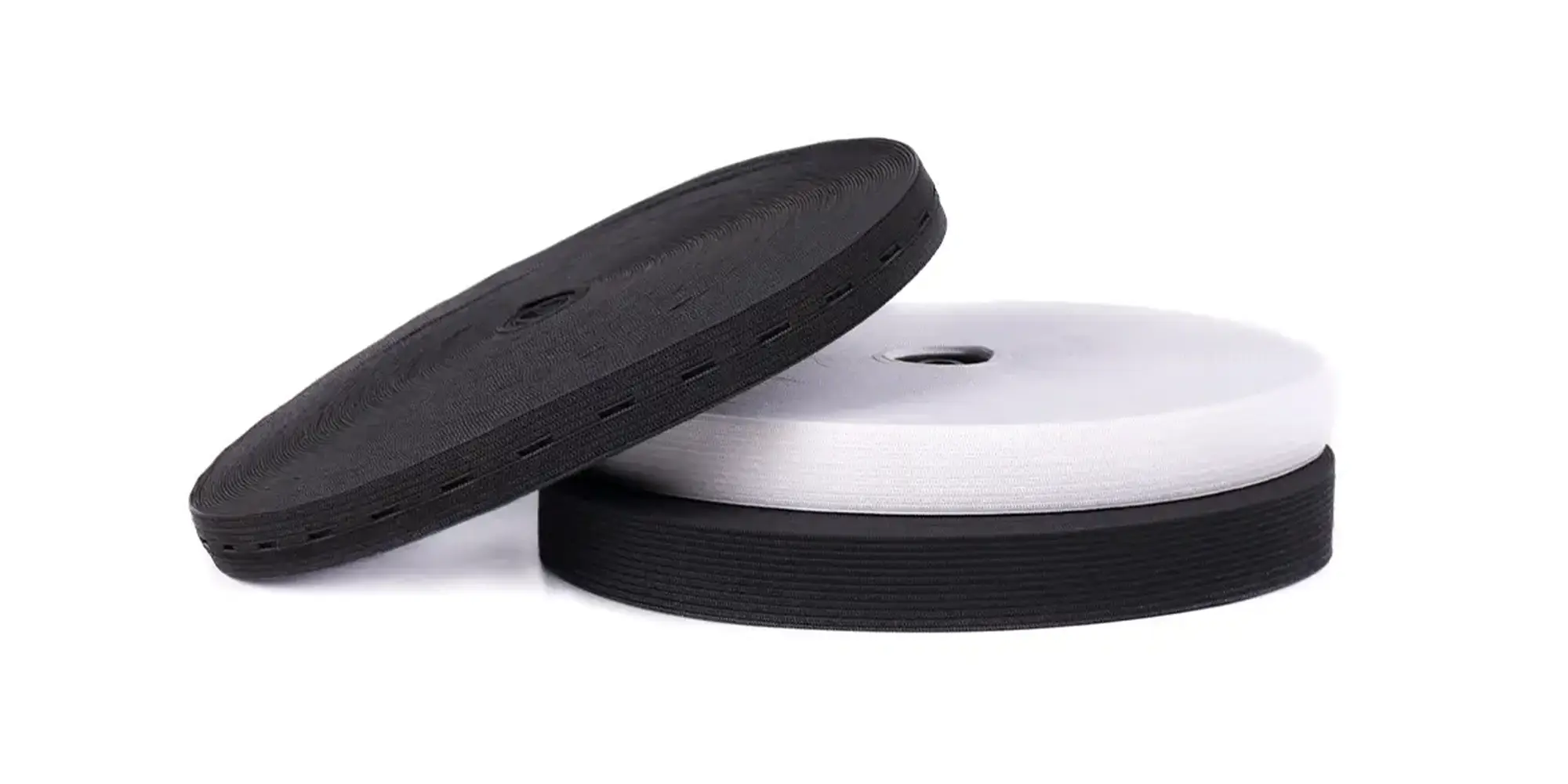
How does each elastic behave under stretch?
The single most important practical difference is whether the band narrows when pulled. Woven does not; knitted and braided do. That one property decides most applications.
| Type | Behaviour under stretch | Feel | Best for |
|---|---|---|---|
| Woven | Keeps its width, lies flat | Firm, structured | Waistbands, heavier apparel, footwear |
| Knitted | Narrows, very flexible | Soft, light | Lightweight apparel, underwear, masks |
| Braided | Narrows, strong recovery | Ribbed, springy | Cuffs, narrow straps, light industrial |
Which elastic types should I choose for my product?
Match the construction to the job:
- Trouser and skirt waistbands → woven, usually 30–50 mm. It keeps its width and will not roll.
- Underwear, lightweight apparel, face masks → knitted. Soft against skin, and the slight narrowing is not a problem.
- Cuffs, gathers, narrow straps, light industrial bands → braided. Strong recovery in an economical narrow band.
- Edge binding on lingerie and babywear → fold-over elastic, a variant that folds over and finishes the edge — see Fold-Over Elastic.
Width matters as much as construction; for sizing by application see our Elastic Sizes guide.